European explorers like the Spanish, French, and Dutch colonized the New World, each with different goals. The Spanish sought quick wealth and religious conversion, leading to harsh treatment of Native Americans. The French and Dutch, focused on trade, fostered friendlier relations with natives, often through intermarriage. Their colonies, New France and New Netherland, were smaller and centered around rivers for easy trade.
French exploration
Spanish successes in the Caribbean attracted the attention of other European nations. Like Spain, France was a Catholic nation and committed to expanding Catholicism around the globe. In the early sixteenth century, it joined the race to explore the New World and exploit the resources of the Western Hemisphere.
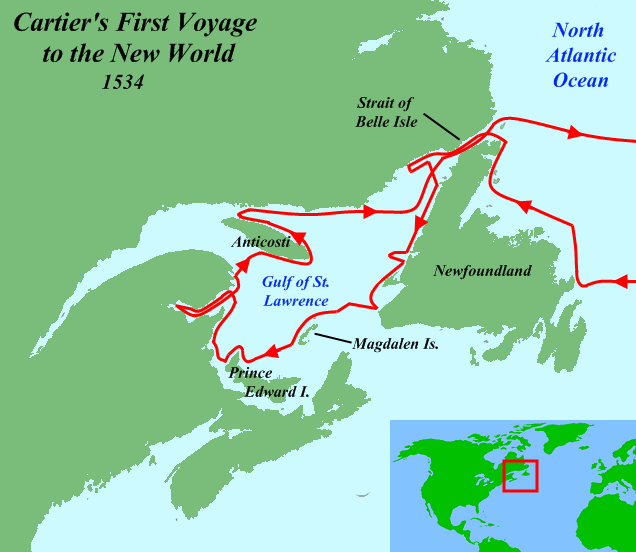
In 1534, navigator Jacques Cartier claimed northern North America for France, naming the area around the St. Lawrence River New France. Like many other explorers, Cartier made exaggerated claims about the area’s mineral wealth and was unable to send great riches back to France or establish a permanent colony.
Map of the area explored by Cartier.
Map of the region explored by Jacques Cartier. Image credit: Wikimedia Commons
Samuel de Champlain made great strides for French exploration of the New World. He explored the Caribbean in 1601 and the coast of New England in 1603 before traveling farther north. In 1608 he founded Quebec, and he made numerous Atlantic crossings as he worked tirelessly to promote New France.
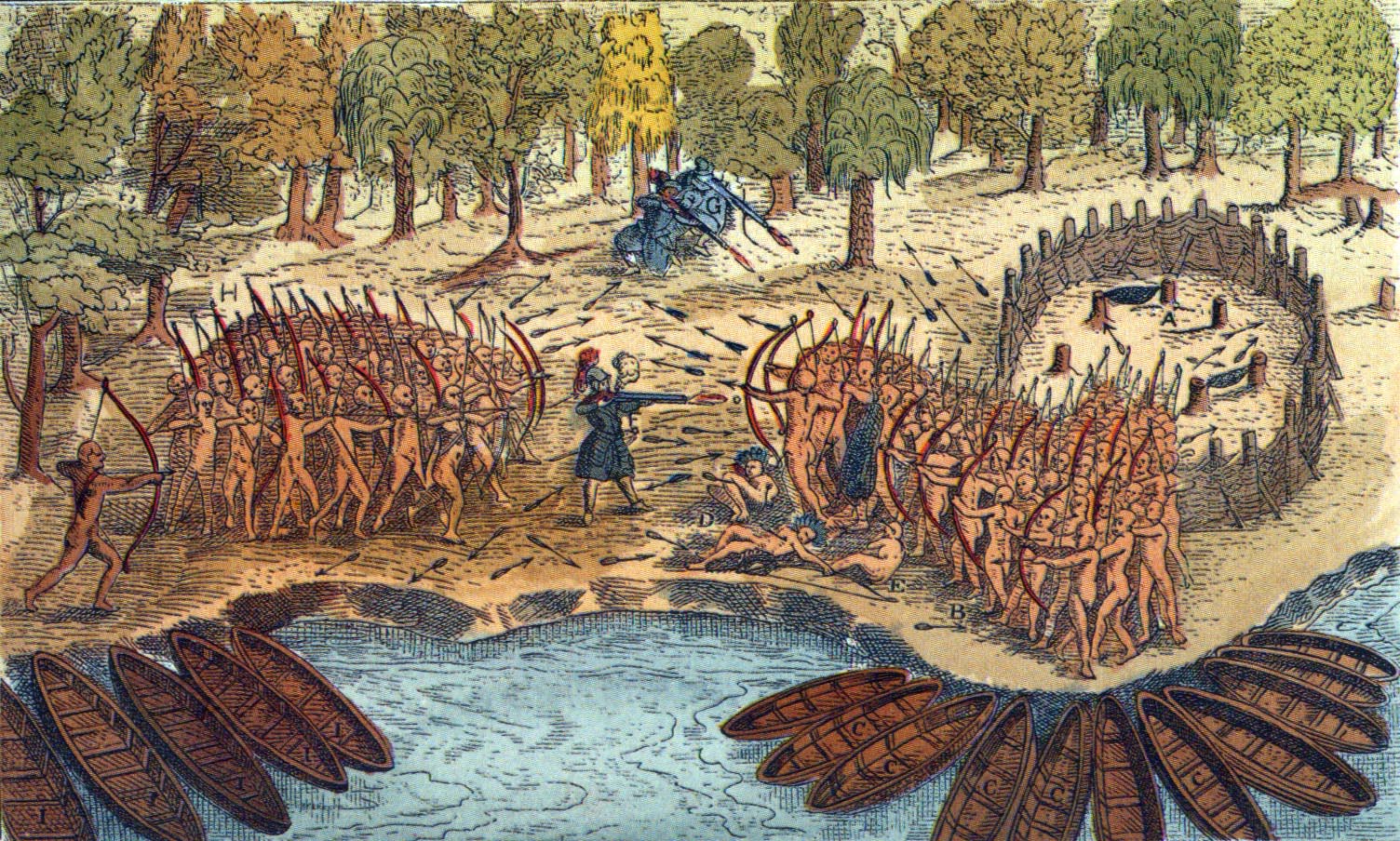
Unlike other imperial powers, France—through Champlain’s efforts—fostered especially good relationships with native peoples as they expanded westward. He learned that becoming friendly with the native people was essential to successful trade. Champlain explored the Great Lakes, Hudson Bay, and eventually made it to the Mississippi River. The French made an alliance with the Hurons and Algonquians; Champlain even agreed to fight for them against their enemy, the Iroquois.
Engraving showing a battle between the Algonquians, the French, and the Iroquois.
Samuel de Champlain, engraving depicting French soldiers fighting with the Algonquians and Hurons against the Iroquois, c. 1609. Image credit: Wikimedia Commons
The French were primarily interested in establishing commercially viable colonial outposts, so they created extensive trading networks throughout New France. They relied on native hunters to harvest furs, especially beaver pelts, and to exchange these items for French goods, like glass beads.
The French also dreamed of replicating the wealth of Spain by colonizing the tropical zones. After Spanish control of the Caribbean began to weaken, the French turned their attention to small islands in the West Indies; by 1635 they had colonized two, Guadeloupe and Martinique. Though it still lagged far behind Spain, France now boasted its own West Indian colonies with lucrative sugar plantation sites and African slave labor.
Dutch colonization
Dutch entrance into the Atlantic World is part of the larger story of religious and imperial conflict in the early modern era. In the 1500s, Calvinism, one of the major Protestant reform movements, began to take root in the Spanish Netherlands and the new sect desired its own state. Holland was established in 1588 as a Protestant nation, but would not be recognized by Spain until 1648.
Determined to imperil Protestantism, King Philip of Spain assembled a massive force of over thirty thousand men and 130 ships, and sent this giant navy, known as the Spanish Armada, towards England and Holland. But the skilled English navy and a maritime storm destroyed the fleet in 1588. The defeat of the Spanish Armada was only one part of a larger but undeclared war between Protestantism and Catholicism.
Quickly, the Dutch inserted themselves into the Atlantic colonial race. They distinguished themselves as commercial leaders in the seventeenth century, as their mode of colonization relied on powerful corporations: the Dutch East India Company, chartered in 1602 to trade in Asia, and the Dutch West India Company, established in 1621 to colonize and trade in the Americas.
While employed by the Dutch East India Company in 1609, the English sea captain Henry Hudson explored New York Harbor and the river that now bears his name. Like many explorers of the time, Hudson was actually seeking a northwest passage to Asia and its wealth (that's why he was employed by the Dutch East India Company instead of the Dutch West India Company), but the wealth of coveted beaver pelts alone provided a reason to claim it for the Netherlands.
The Dutch named their colony New Netherlands, and it served as a fur-trading outpost for the expanding and powerful Dutch West India Company. They expanded in the area to create other trading posts, where their exchange with local Algonquian and Iroquois peoples brought the Dutch and native peoples into alliance. The Dutch became a commercially powerful rival to Spain--Amsterdam soon became trade hub for all the Atlantic World.
The first English colony at Roanoke
Religious competition between Catholicism and Protestantism fueled English colonization, although England lacked the financial resources for such endeavors. Nonetheless, as early as 1497, Henry VII of England had commissioned John Cabot, an Italian mariner, to explore new lands. Cabot sailed from England that year and explored Maine and Nova Scotia. Thereafter, English fishermen routinely crossed the Atlantic to fish the rich waters off the east coast.
However, English colonization efforts in the 1500s were closer to home, as England devoted its energy to the colonization of Ireland. Queen Elizabeth I was preoccupied with blocking Spain’s effort to eliminate Protestantism. Still, Elizabeth encouraged English privateers to plunder Spanish ships whenever they could. Each year the English took more than £100,000 from Spain in this way; English privateer Sir Francis Drake first made a name for himself when, in 1573, he looted silver, gold, and pearls worth £40,000.
Elizabeth did sanction an early attempt at colonization in 1584, when Sir Walter Raleigh attempted to establish a colony at Roanoke, an island off the coast of present-day North Carolina. The colony was small, consisting of only 117 people, who seem to have alienated the native Croatan people. They struggled to survive. Their governor, John White, returned to England in late 1587 to secure more people and supplies. When he returned in 1590, only three years later, the entire colony had vanished. The only trace the colonists left behind was the word Croatoan carved into a fence surrounding the village.
Roanoke is still called “the lost colony,” and what happened to the colonists is still a mystery. However, English promoters of colonization would continue to explore the New World in the years to come despite this curious failure.
Engraving depicting Roanoke governor John White returning to the colony with a group of English people, examining a tree with the carving 'CROATOAN.'
Engraving depicting governor John White returning to the site of the Roanoke colony. Image credit: Wikimedia Commons
What do you think?
What role did the colonies play in the European race for geopolitical dominance?
The colonies played a significant role in the European race for geopolitical dominance during the Age of Exploration and subsequent centuries. Here are some key aspects of their role:
Economic Power: Colonies provided European powers with valuable resources such as gold, silver, spices, sugar, tobacco, and other raw materials. These resources fueled the economies of European nations and contributed to their wealth and power.
Trade Routes: Colonies served as strategic points along global trade routes. Controlling colonies allowed European powers to dominate trade networks and establish lucrative trading relationships.
Military and Naval Bases: European colonies often served as military and naval bases, enabling European powers to project their military strength across vast distances. This was particularly important for protecting trade routes and securing territories against rival powers.
Expansion of Influence: The establishment of colonies allowed European nations to expand their influence and assert dominance over regions previously unexplored or controlled by other powers. This expansion helped solidify their status as global powers.
Competition Among European Powers: The competition for colonies led to conflict and competition among European powers. This competition was evident in conflicts such as the Anglo-Spanish War, Anglo-Dutch Wars, and various conflicts between European powers in Asia, Africa, and the Americas.
Cultural Exchange: Colonies served as cultural melting pots where European, indigenous, and African cultures often blended. This exchange of ideas, languages, and customs had a lasting impact on both the colonies and the home countries.
Scientific and Technological Advancements: Exploration of colonies spurred advancements in navigation, cartography, shipbuilding, and other technologies. These advancements had wide-ranging effects beyond the colonies themselves.
Overall, the colonies were central to the European race for geopolitical dominance, providing wealth, resources, strategic advantages, and a means to expand influence and control over vast parts of the world. This period of colonialism had profound and lasting effects on the global landscape, shaping the modern world in numerous ways.
Which European country raised the biggest threat to Spanish dominance in the New World and why?
The European country that posed the biggest threat to Spanish dominance in the New World was England. There are several reasons for this:
Privateers and Pirates: English privateers and pirates, such as Sir Francis Drake and Sir Walter Raleigh, raided Spanish treasure ships returning from the Americas. These raids severely disrupted Spain's flow of wealth from the New World, weakening its economic power.
Naval Power: England developed a powerful navy, which was instrumental in challenging Spanish dominance. The English defeat of the Spanish Armada in 1588 is a famous example of this naval strength. This victory not only boosted English morale but also weakened Spain's naval superiority.
Colonial Rivalry: England established successful colonies in North America, such as Jamestown in 1607 and Plymouth in 1620. These colonies grew and thrived, creating competition for Spanish territories and resources.
Trade Rivalry: English merchants sought to challenge Spain's monopoly on trade with its colonies. They established the East India Company and other trading ventures to compete with Spanish trade networks.
Religious Conflict: England was in the midst of the Protestant Reformation, while Spain remained staunchly Catholic. This led to religious conflicts and political tensions, with England seeing Spain as a Catholic threat.
Strategic Alliances: England formed alliances with other European powers, such as the Dutch Republic, to further challenge Spanish dominance. Together, they fought against Spain in conflicts such as the Eighty Years' War (Dutch Revolt).
Expansionist Ambitions: English monarchs, such as Queen Elizabeth I, sought to expand England's influence and territories. This drive for expansion clashed directly with Spain's interests in the New World.
In summary, England's naval power, colonial ambitions, trade interests, and strategic alliances all contributed to its status as the biggest threat to Spanish dominance in the New World. The rivalry between these two powers shaped the course of history in the Americas and had significant implications for global geopolitics.
How did new trade relationships between European nations and natives connect the two worlds? How did it divide them?
The establishment of new trade relationships between European nations and indigenous peoples in the Americas had profound effects on both worlds. It connected the two worlds in several ways, but it also led to divisions and conflicts:
Connections:
Exchange of Goods: Trade introduced European goods such as textiles, metal tools, weapons, and glass to the Americas. In return, European traders received products like fur, tobacco, sugar, gold, and silver from the Americas. This exchange of goods enriched both sides economically.
Cultural Exchange: Trade also facilitated a cultural exchange between Europe and the Americas. Europeans learned about indigenous customs, languages, foods, and technologies, while indigenous peoples were introduced to European languages, religion, and customs.
Spread of Ideas: The trade networks allowed for the spread of ideas, knowledge, and technologies. For example, European agricultural methods and crops were introduced to the Americas, while indigenous knowledge of plants and medicines was shared with Europeans.
Establishment of Settlements: European traders often established trading posts and settlements along trade routes, creating points of contact between the two worlds. These settlements sometimes led to the intermingling of European and indigenous populations.
Divisions and Conflicts:
Competition for Resources: European nations often competed with each other for control of trade routes, territories, and resources in the Americas. This competition led to conflicts and wars among European powers, such as the Anglo-Spanish War and the French and Indian War.
Disease and Depopulation: The arrival of Europeans brought diseases such as smallpox, measles, and influenza to which indigenous populations had no immunity. These diseases devastated native communities, leading to significant depopulation and social disruption.
Forced Labor and Slavery: European demand for labor in the Americas led to the enslavement of millions of indigenous peoples and the transatlantic slave trade. This exploitation of labor created deep divisions and social injustices that continue to impact societies today.
Cultural Assimilation and Loss: As Europeans established colonies and trading posts, they often imposed their cultures, languages, and religions on indigenous peoples. This led to the loss of indigenous languages, traditions, and ways of life.
Land Displacement: European colonization often involved the displacement of indigenous peoples from their ancestral lands. This led to conflicts over land ownership and sovereignty, as well as the loss of traditional territories and resources.
In summary, while new trade relationships between European nations and indigenous peoples connected the two worlds through the exchange of goods, ideas, and technologies, they also created divisions and conflicts. The impacts of these trade relationships were complex and multifaceted, shaping the course of history in both Europe and the Americas.
Get link
Facebook
X
Pinterest
Email
Other Apps
Comments
Popular posts from this blog
China China’s modern position as a global power is the result of a complex historical evolution that has seen the country transition from an isolated imperial state to a dominant economic and political force. This rise has not only shaped the internal dynamics of Chinese society but has also influenced its role in the global landscape. Several pivotal moments have defined China’s trajectory, including the 1949 Communist Revolution and the sweeping economic reforms of the late 20th century. Today, China plays a crucial role in shaping global economic trends, international diplomacy, technological innovation, and environmental strategies. Understanding China’s socio-political and economic positioning requires a deep examination of its historical context, governance structure, economic development, social dynamics, and foreign policy strategies. Historically, China’s transformation began with the decline of the Qing Dynasty, which marked the end of imperial rule and ushered in...
Coming Out: Queer Erasure and Censorship from the Middle Ages to Modernity Bible, about 1280–90, Bologna, Italy. The J. Paul Getty Museum, Ms. Ludwig I 11, fol. 248v; National Coming Out Day (NCOD) Logo created and donated by Keith Haring to the Human Rights Campaign. Bible, about 1280–90, Bologna, Italy. The J. Paul Getty Museum, Ms. Ludwig I 11, fol. 248v; National Coming Out Day (NCOD) Logo created and donated by Keith Haring to the Human Rights Campaign . This post acknowledges and discusses important—but often overlooked—aspects of premodern life, relationships, and identities that existed beyond the gender binary (female and male) or heteronormative couplings (a man and a woman). As curators of and specialists in medieval and Renaissance illuminated manuscripts (books made and painted by hand), our focus will be objects from the Getty collection that were produced in premodern Europe from about 1200 to 1600; we will consider the ways in which images and te...
First China The 5th millennium BC was a defining period in human history, marked by the stabilization and gradual growth of populations that had been set in motion by the transformative Neolithic Revolution. This era saw humans transition further from nomadic, hunter-gatherer societies to complex, settled agricultural communities. As these societies became more sophisticated, they developed innovative strategies to manage and protect the land, support population growth, and ensure long-term sustainability. These advancements in agriculture, technology, and societal organization not only stabilized populations but also laid the foundation for the rise of civilizations that would dominate the millennia to come. Factors Contributing to Population Growth One of the key drivers of population growth during the 5th millennium BC was the establishment of agriculture, which provided a stable and abundant food supply. The Neolithic Revolution had already begun to transform human life by rep...


Comments
Post a Comment