Part 3 Comparing European and Native American cultures
Comparing European and Native American cultures
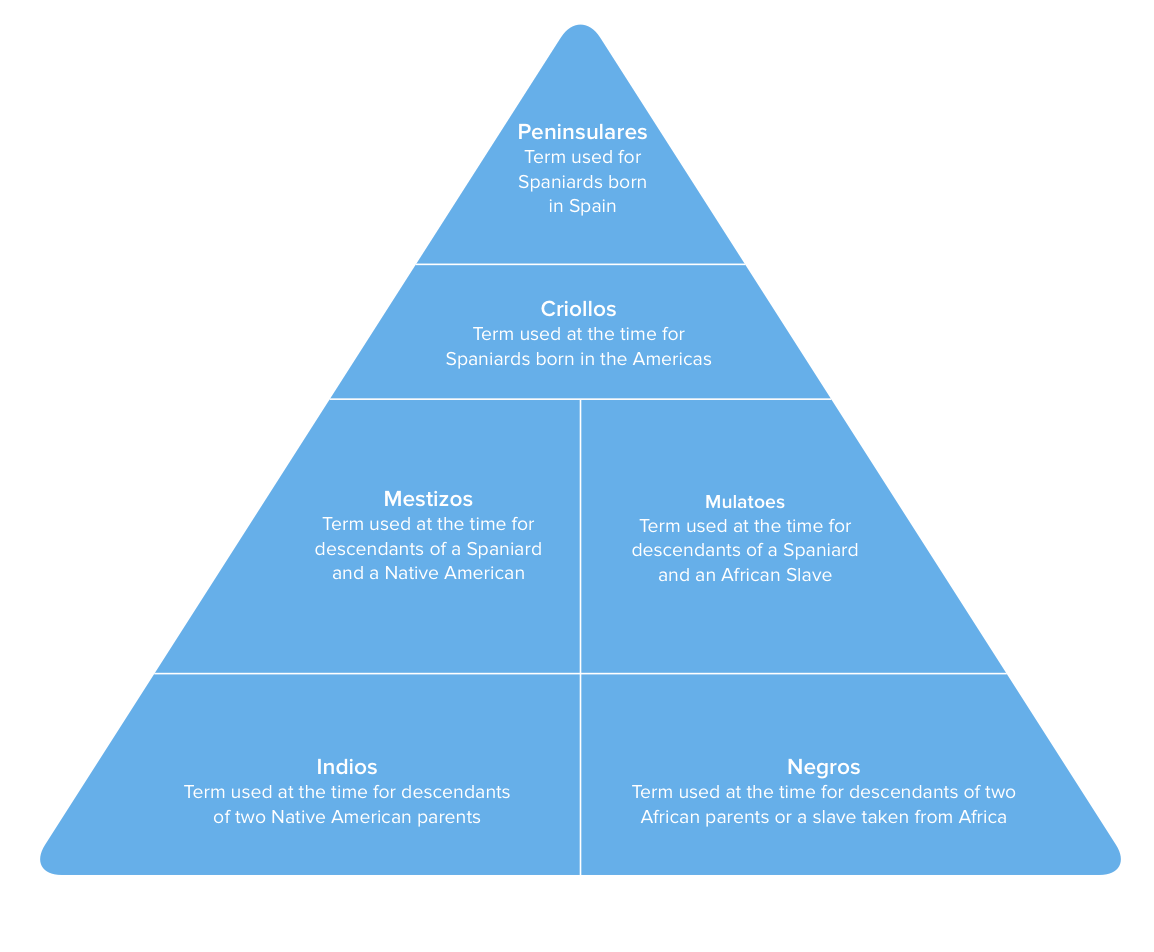
The Spanish colonial caste system
Core historical themes
Review questions
What were the three main motivating factors for the Spanish to begin colonizing?
The three main motivating factors for Spanish colonization were:
Wealth and Resources: One of the primary motivations for Spanish colonization was the desire to acquire wealth, especially through the discovery of gold, silver, and other valuable resources. The Spanish conquistadors sought riches and treasures in the Americas, particularly in regions such as Mexico, Peru, and Bolivia. The legendary wealth of the Aztec and Inca civilizations, in particular, attracted Spanish explorers and adventurers.
Spread of Christianity: Another significant motivation for Spanish colonization was the desire to spread Christianity, specifically Catholicism. Spanish monarchs saw the exploration and colonization of new lands as an opportunity to convert indigenous peoples to Christianity. This led to the establishment of missions and the work of missionaries throughout the Americas, with the goal of converting native populations and bringing them into the fold of the Catholic Church.
Glory and Power: The pursuit of glory, fame, and power was also a key factor driving Spanish colonization. Conquistadors and explorers sought to expand the Spanish Empire, enhance their own social status, and gain recognition for their achievements. Many of these individuals were driven by a thirst for adventure and a desire to leave their mark on history. The Spanish Empire, under the rule of monarchs such as Ferdinand and Isabella, aimed to establish dominance over vast territories, asserting Spain's power on the global stage. This drive for glory and power fueled the conquest and colonization of large parts of the Americas.
The integration of both Native Americans and enslaved Africans into Spanish colonial society had significant and lasting implications, shaping the social, cultural, and economic landscape of the Americas. Here are some of the key implications:
Cultural Hybridity: The integration of Native Americans and Africans into Spanish colonial society resulted in a blending of cultures. This cultural hybridity was particularly evident in language, religion, art, music, and cuisine. For example, Spanish, indigenous, and African languages often merged to create new dialects such as Spanish-based Creole languages. Similarly, religious practices and beliefs intermingled, leading to syncretic forms of Catholicism mixed with indigenous and African spiritual traditions.
Social Hierarchy and Caste System: The Spanish colonial system was structured around a rigid social hierarchy based on race and ancestry. This hierarchy, known as the caste system, placed those of European descent at the top, followed by mixed-race individuals (mestizos), then Native Americans, and finally Africans and their descendants (mulattos). This system determined one's legal rights, social status, and opportunities. Mestizos often occupied an intermediate position, serving as intermediaries between the Spanish elite and indigenous populations.
Labor Systems and Economic Development: The integration of enslaved Africans into colonial society played a crucial role in the development of labor systems, particularly in industries such as mining, agriculture, and ranching. Enslaved Africans were used extensively as laborers in mines and plantations, contributing to the extraction of valuable resources such as gold, silver, sugar, and other cash crops. Native Americans were also forced into labor, often through the encomienda and repartimiento systems, which were forms of coerced labor that exploited indigenous populations for economic gain.
Erosion of Indigenous Societies: The integration of Native Americans into Spanish colonial society led to profound changes in indigenous communities. European diseases, warfare, forced labor, and cultural suppression resulted in a drastic decline in indigenous populations. Many indigenous groups were decimated, and their traditional ways of life were disrupted or destroyed. In some cases, survivors of these communities were integrated into Spanish society, adopting Spanish customs, languages, and religions.
Resistance and Revolts: Both Native Americans and enslaved Africans resisted Spanish colonization through various means, including armed uprisings, rebellions, and the preservation of their cultural traditions in secret. Famous revolts such as the Túpac Amaru II rebellion in Peru and the Haitian Revolution in Saint-Domingue (now Haiti) demonstrated the resilience and determination of indigenous and African peoples to resist colonial oppression.
Overall, the integration of Native Americans and enslaved Africans into Spanish colonial society resulted in complex and dynamic social dynamics that continue to shape the cultural heritage and societal structures of many countries in the Americas today. These historical legacies remain important subjects of study and reflection in understanding the diversity and complexity of the region's history.
The interactions between Native Americans and the Spanish in the context of colonialism led to a complex process of cultural exchange and adaptation. Both groups influenced each other in various ways, leading to the integration of aspects of each other's cultures. Here are some ways in which this cultural exchange occurred:
Language: One of the most evident aspects of cultural exchange was the blending of languages. Spanish became the dominant language in many parts of the Americas, but it also absorbed numerous words from indigenous languages. Similarly, indigenous languages borrowed Spanish words, leading to the creation of new dialects and languages, such as the various forms of Spanish creole spoken in the Caribbean and parts of Central and South America.
Religion: The introduction of Christianity by the Spanish had a profound impact on indigenous societies. Native Americans often blended their traditional beliefs with Catholic practices, creating syncretic religious practices. This blending of beliefs and practices resulted in the development of new forms of religious expression, such as the worship of Catholic saints alongside traditional indigenous deities.
Cuisine: The exchange of foodstuffs was significant. Native American foods such as maize (corn), potatoes, tomatoes, and various types of beans became staples in Spanish cuisine. Conversely, Spanish ingredients and cooking techniques were introduced to Native American societies. This cultural exchange gave rise to new dishes and culinary traditions.
Architecture and Urban Planning: The Spanish introduced European architectural styles to the Americas, but they often incorporated indigenous building techniques and materials. In many colonial cities, such as Mexico City and Cusco, you can see a blend of Spanish and indigenous architectural elements. Additionally, the layout of towns and cities often combined Spanish urban planning with indigenous concepts of city design.
Art and Craftsmanship: Indigenous artists and craftsmen adopted European artistic techniques brought by the Spanish, such as painting, sculpture, and metalworking. At the same time, they often incorporated their own traditional designs, materials, and motifs into these new forms, creating a unique fusion of styles.
Social Structure: The Spanish introduced a hierarchical social structure based on European norms, with themselves at the top. However, this structure often incorporated elements of indigenous social organization. For example, in some areas, indigenous leaders retained a degree of authority under Spanish colonial rule, acting as intermediaries between the Spanish authorities and their communities.
Clothing and Fashion: The blending of clothing styles was also evident. Indigenous people often adopted elements of Spanish dress, such as certain types of clothing and footwear, while maintaining traditional garments. Similarly, Spanish settlers sometimes adopted elements of indigenous clothing for practical reasons, such as the use of ponchos or sandals.
These are just a few examples of the ways in which Native Americans and the Spanish adapted aspects of each other's cultures during the colonial period. This process of cultural exchange, while often complex and marked by power imbalances, contributed to the rich and diverse cultural heritage of the Americas today.
(Choice C) elements of Pueblo religion and Catholicism fusing together
This is an example of syncretism, where elements of two or more different belief systems, religions, or cultural traditions blend or merge to form a new, often unique, system of beliefs or practices. In the context of the Spanish colonization of the Americas, syncretism often occurred as indigenous populations adapted to the new religion of Catholicism introduced by the Spanish, blending it with their existing religious beliefs and practices. This blending resulted in new forms of worship, rituals, and expressions of faith that incorporated elements from both traditions.
(
Choice A) The Andean Mountains of South America
The Inca Empire was a civilization located in the Andean Mountains of South America, specifically in the region that is now Peru, Bolivia, Ecuador, and parts of Colombia, Chile, and Argentina. The rugged terrain of the Andes provided a natural fortress for the Inca civilization, allowing them to build their empire and develop a powerful federal government.


Comments
Post a Comment